
◆ ANTIQUE DIAMOND CUTS
A flat base, a domed crown and about five centuries of history. Here is how the rose cut began, how it behaves in light, and why it has become a favorite for alternative bridal.
Table of Contents
A rose cut diamond is a diamond with a flat bottom and a domed top covered in triangular facets that rise to a point, a bit like a closed rosebud. Cutters in Antwerp were shaping them by the 1500s, well before the round brilliant existed, and for generations they were the standard way to cut a diamond for jewelry.
Then fashion chased sparkle, and the rose cut diamond drifted into antique shops and family jewelry boxes. Now it is back. Couples who want a ring that doesn’t look like everyone else’s keep landing on it, and salt and pepper stones have made it feel fresh again. This guide covers where the cut came from, how it looks in light, and how to choose one.
Rose cut diamond at a glance
- Shape: Flat base, domed crown, no pavilion
- Facets: A handful on simple roses, up to 24 on the full-Dutch
- Origin: Antwerp workshops, 1500s
- Look: A soft glow rather than sharp sparkle
- Best for: Bezel or low-profile settings
What Is a Rose Cut Diamond?
A rose cut diamond has a flat, unfaceted base and a dome made of triangular facets that meet at a single point at the top. There is no pavilion underneath and no large flat table on top. GIA’s gemologists describe rose cuts as a family of faceting styles that share one trait: none of them has a flat table.
The number of facets varies. Simple roses have only a few, while the classic full-Dutch rose has 24. Because the older stones were cut by hand, no two look quite alike, which is part of the appeal.
Why Is It Called a Rose Cut?
The name comes from the stone’s resemblance to an opening rosebud, its facets folding together like petals. You will also see it called a rosette, and it is sometimes sold as a “rose diamond.”
The Anatomy of a Rose Cut Diamond
Rose cut
Round brilliant
Side profiles of a rose cut diamond and a round brilliant. Everything the rose cut leaves out below the girdle is what changes how it looks and feels.
That missing pavilion is the whole story: light enters through the dome and has no deep lower half to bounce around in, so the stone glows instead of flashing.
The History of the Rose Cut Diamond
The rose cut diamond is one of the oldest ways of faceting a stone.
Antwerp and the First Roses
Before roses came the point cut, where cutters simply polished the natural faces of an octahedral crystal. According to GIA research on baroque-era rose cuts, the rose came next. It started from a rough cleavage fragment split off an octahedron, and it was a typical product of the sixteenth and seventeenth centuries. That helps explain the flat base: the rough already came with one, so the cutter only had to shape the dome.
The Antwerp, Dutch and Double Rose
Cutters kept refining the pattern, and the names follow the facet count. Here is how the main members of the family compare.
| Variant | Facet plan | Total facets | Worth knowing |
|---|---|---|---|
| Antwerp rose | 6 + 6 | 12 | Earliest, simplest pattern |
| Half-Dutch rose | 6 + 12 | 18 | A middle step between the two |
| Full-Dutch rose | 6 + 18 | 24 | The classic rose cut diamond |
| Double rose | Two roses base to base | Varies | Faceted on both sides, no flat bottom |
Dealers sometimes quote different numbers for the Dutch rose, so count a stone’s real facets rather than trusting a label.
Georgian and Victorian Glow
Through the Georgian and Victorian eras, the rose cut diamond was a jewelry staple, set into everything from brooches to rings. It’s often said that its soft glow flattered candlelit rooms, and that’s plausible: it doesn’t need hard white light to look good.
Meanwhile the old mine and old European cuts, and later the round brilliant, spread through the 1700s and 1800s. Cutters began chasing fire and brilliance, and the rose slipped from the main stage. Sources disagree on exactly when that decline set in, so treat any single date with caution.
The Rose Cut Timeline at a Glance
From Antwerp workshop to alternative bridal
1500S
Antwerp roses
Cutters shape flat rough into the first rose cuts.
1600S
Dutch roses
Facet plans settle at 12, 18 and 24.
1700S TO 1800S
Georgian and Victorian
A jewelry staple as brilliant-style cuts spread.
1900S
Sparkle takes over
Brilliant cuts become the standard.
TODAY
Alternative bridal
Soft glow, low profile, one-of-a-kind stones.
Infographic: the rose cut diamond timeline, from 16th-century Antwerp to the modern revival.
The Character of a Rose Cut Diamond
A Glow, Not a Flash
A brilliant cut is engineered to bounce light back out of the top in sharp flashes. A rose cut diamond works differently. With no deep pavilion underneath to return light, the result is a soft, silky luster. It glows rather than sparkles. If you want fireworks, buy a brilliant. If you want a quiet shimmer that shifts as you move, this is the cut.
The Flat Bottom Diamond Advantage
Because a flat bottom diamond carries no weight below the girdle, its carat weight is spread across the top. In practice, a rose cut diamond looks larger face-up than a brilliant of the same weight. Turn that around and it also means a rose cut that matches the width of a brilliant weighs less, so you are paying for fewer carats. The low profile also sits close to the finger and is less likely to snag.
The Honest Trade-Offs
What you gain
A bigger face-up look per carat
A soft, vintage glow
A low, comfortable profile
What you give up
Fire and sharp white sparkle
Hiding places for inclusions
Standard cut grades
Cut grading scales were designed for round brilliants, so a rose cut diamond is judged by eye. Look at symmetry, polish and how neatly the facets meet at the apex.
A brilliant cut asks the light to perform. A rose cut diamond lets it rest.
Rose Cut vs Old Mine, Old European and Brilliant Cuts
People mix these cuts up constantly. Here is the quick way to tell a rose cut diamond from its look-alikes.
| Feature | Rose cut | Old mine / Old European | Round brilliant |
|---|---|---|---|
| Underside | Flat base, no pavilion | Deep pavilion with a large culet | Pointed pavilion |
| Top | Dome of triangular facets | Small table, high crown | Large flat table |
| Light | Soft, even glow | Broader, warmer flashes | Sharp white sparkle |
| Face-up size per carat | Largest | Smaller | Smaller |
Weighing the rose against other antique shapes? Our guide to rose cut vs old cut diamonds compares them stone by stone.
Why Rose Cut Salt and Pepper Diamonds Work So Well
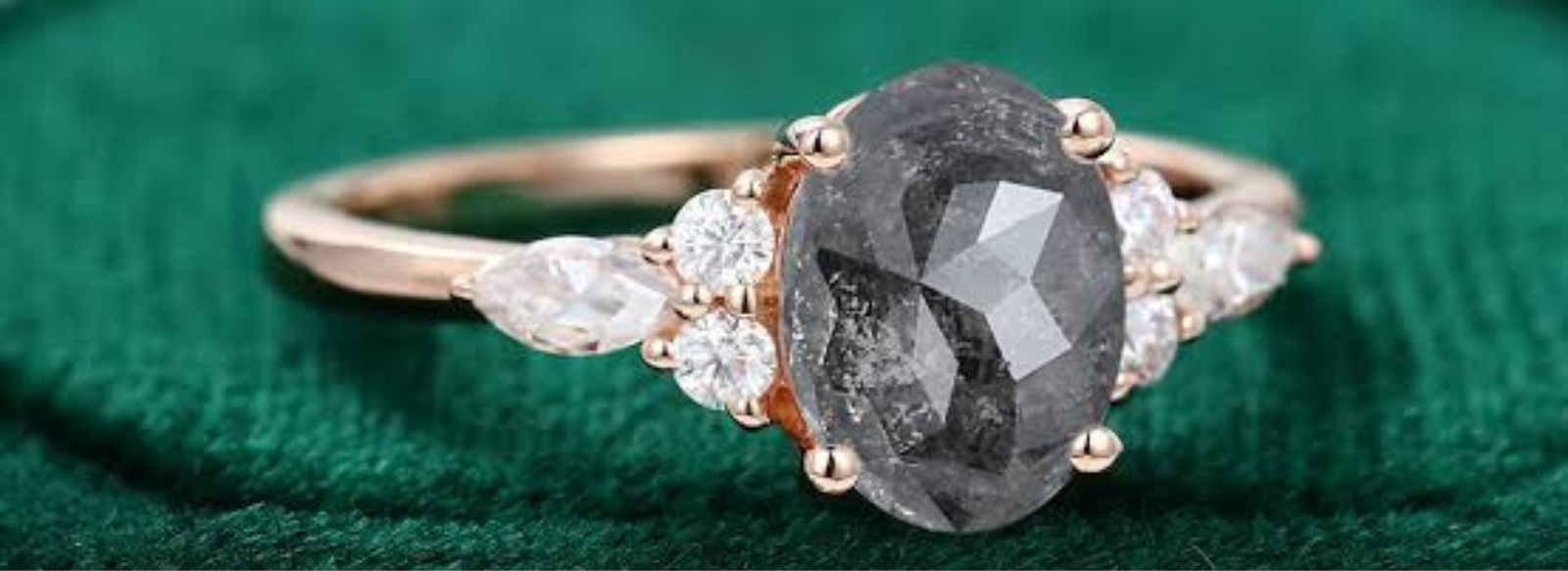
A salt and pepper diamond is full of natural black and white inclusions. Instead of a clear white stone, you get a speckled, smoky pattern that people often compare to a night sky. Each one is different.
Put that stone in a rose cut and something clicks. With no deep pavilion in the way, the flat crown gives a clear view into the diamond, so the inclusions show up. On a colorless diamond that is a flaw. On a rose cut salt and pepper stone it is the point: you are looking straight at the pattern.
That pairing is our take rather than a rule, but it explains why the two keep appearing together in alternative bridal rings.
How to Choose a Rose Cut Salt and Pepper Diamond
1
Study the pattern.
Even speckling reads soft, heavy clusters read bolder. Pick the one you will love in ten years.
2
Check the inclusion color.
Some carry hints of brown, gray or red. Look in daylight.
3
Look at the edges.
Check the girdle for chips, especially on antique pieces.
4
Check the dome.
Facets should meet cleanly at the apex, and the stone should sit level.
5
Ask for millimeters.
Carat weight alone can mislead on a shallow cut. Millimeters show how big it will look.
To see these patterns in person, browse our salt and pepper diamonds.
The Rose Cut’s Revival in Alternative Bridal
Alternative bridal is a simple idea: skip the default round solitaire and choose something with character. The rose cut diamond fits that brief almost by accident. It is historic without being fussy, and it looks bigger than its weight suggests.
The setting matters as much as the stone. Three approaches work especially well.
Bezel
A metal rim protects the girdle and echoes the low profile. The safest choice for daily wear.
Low-profile prong
Lets more light reach the crown. Pick a jeweler used to flat-based stones.
Halo
Small accent diamonds add sparkle around the soft glow of the center stone.
Ready to compare real stones? Our collection of rose cut loose diamonds lets you look at shapes, sizes and patterns side by side before you choose a setting.
How to Care for a Rose Cut Diamond
Diamond is the hardest natural material, but hard is not the same as indestructible, and this cut has exposed edges that deserve a little respect.
Clean gently. Warm water, mild soap, a soft brush.
Store it apart. Use its own pouch so nothing knocks the edges.
Protect the edges. Remove the ring for heavy lifting or the gym; a bezel helps.
Check the setting. Have a jeweler inspect antique pieces now and then.
Rose Cut Diamond FAQs
What is a rose cut diamond?
A rose cut diamond is a diamond with a flat base and a domed crown of triangular facets that meet at a point. It dates to the 1500s and has no pavilion underneath.
Does a rose cut diamond sparkle?
Not in the way a brilliant cut does. A rose cut diamond gives a soft, silky glow rather than sharp flashes of white light. If you want maximum sparkle, a brilliant cut is the better choice.
Are rose cut diamonds cheaper than brilliant cuts?
Often, for the same visible size, but not always. A rose cut diamond weighs less than a brilliant of the same width, so you pay for fewer carats. Quality, rarity and origin still affect the price, so compare stones one by one.
What is a rose cut salt and pepper diamond?
It is a salt and pepper diamond, one filled with natural black and white inclusions, that has been cut as a rose cut. The flat, open crown lets the speckled pattern show clearly.
Is a rose cut diamond durable enough for an engagement ring?
Yes, with the right setting. Diamond is extremely hard, but exposed edges can chip. A bezel plus regular jeweler checks keeps a rose cut diamond safe for daily wear.
See Rose Cut Loose Diamonds
Found the look you like? Browse our rose cut loose diamonds and compare patterns, shapes and sizes. Every stone is different, so take your time.
How this guide was researched
Facet counts and historical details come from GIA’s Gems & Gemology research and were cross-checked against published guides from antique and fine-jewelry dealers. Where sources disagree, we say so. Comments on sparkle and price reflect general trade understanding, not a substitute for inspecting a stone in person.